

A professional publisher sells one thing above all: answers a reader can rely on. A treatise, a practice guide, a rulebook or a handbook is worth its price because someone checked every page of it. However, more and more readers take their question to a general-purpose chatbot first. The answer sounds right, it is free, and nobody checked it. The book stays accurate and unread.
Since 2024, we at 4xxi have been building the other option: Edtek. Its Chat product is an AI chatbot for publishers and institutions: it turns a library they already own into answers from that library and nothing else. Below is what we learned, including when you do not need any of this.
Short answer: a publisher, association or institution can turn its books, handbooks and rule sets into an AI chatbot that answers only from them. Each claim carries a numbered citation that opens the cited page, and when the content has no answer, the reader is told so. Edtek Chat, the product we build at 4xxi, works this way. The American Arbitration Association has run its AAAi Chat Book on it since January 2025; as of October 2026, four editions are live.
What do publishers and institutions actually want from AI?
They want answers that cite the page, and a refusal when no page supports the answer. Our conversations with publishers and institutions keep coming back to the same list, whatever the subject of their books:
- Answers only from our content. Not from the open internet, and not from what the model happens to remember.
- A citation the reader can check. Not ‘Source: Handbook’, but the page and the passage.
- An honest ‘no’. When the content does not cover the question, the reader should hear exactly that.
- Our brand, our reader. The reader stays on the publisher’s site, under the publisher’s name.
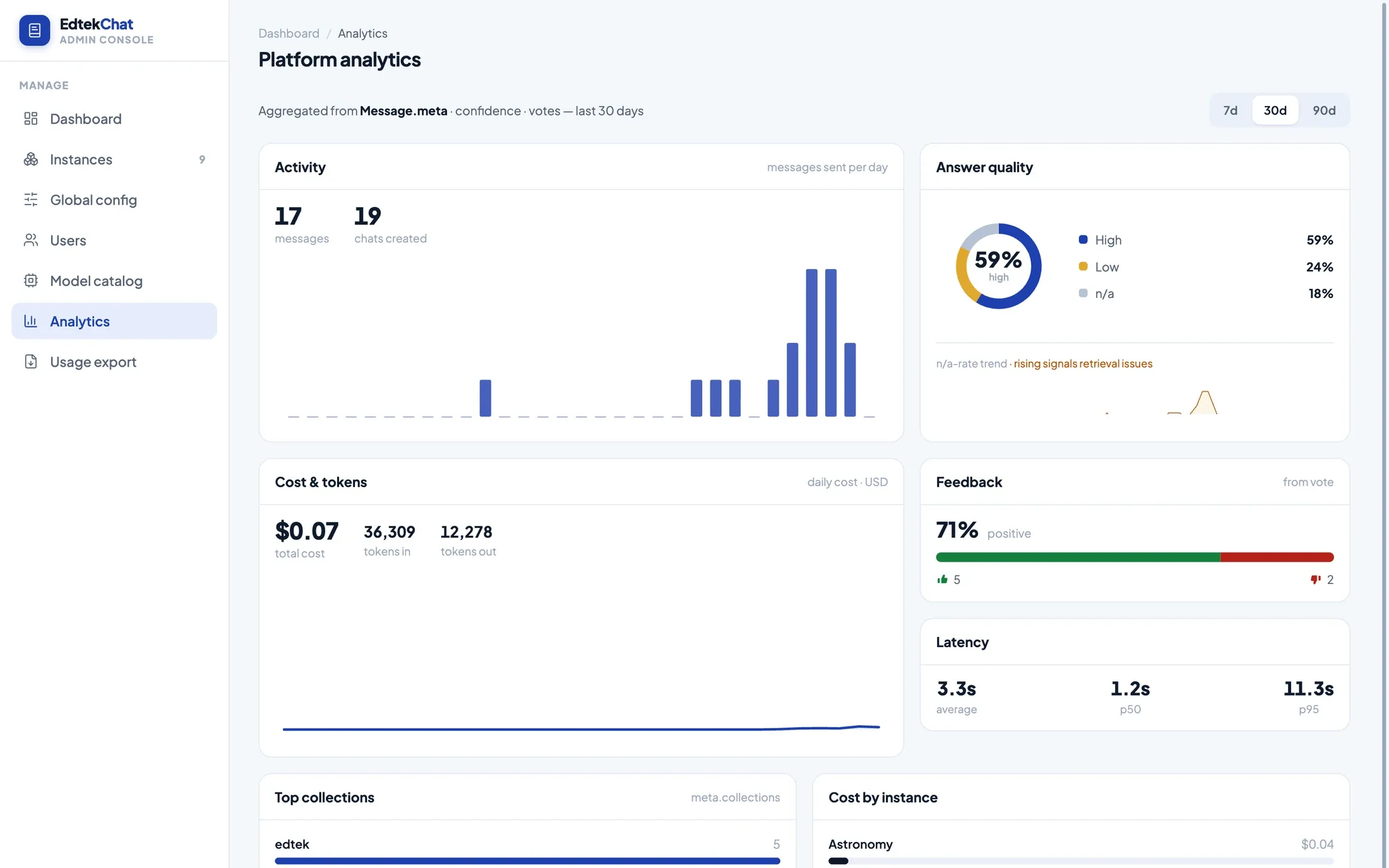
- Numbers. Which titles answered which questions, what an answer costs, and whether quality dropped after the last change.
Why so strict? Because in professional content a wrong answer with your logo on it is worse than no answer. Even large legal research vendors, which retrieve from their own databases, are not immune: a 2024 Stanford study found that the AI research tools of LexisNexis and Thomson Reuters each hallucinated between 17% and 33% of the time (Magesh et al.). So retrieval alone is not enough. What matters is what the system is allowed to do with what it retrieved.
Should you license your content to AI companies or own the answer layer?
In my opinion, a professional publisher should own the answer layer and treat licensing as a separate, optional deal. The two are not mutually exclusive, but they sell different things. Licensing sells your text to someone else’s product, as training or grounding material. Owning the answer layer sells the answer itself, under your name, to your reader.
Licensing money is real. Wiley reported $40 million of AI licensing revenue in fiscal 2025, up from $23 million a year before (Wiley, June 2025). However, after such a deal the reader asks someone else’s assistant, and whether it cites your page, or mentions you at all, is not your decision anymore. For a publisher whose whole value is that an answer can be checked against the page, I think it is a bad trade if it is the only one. The wider picture is in our pieces on AI development for legal publishers and AI use cases in legal publishing.
Google made this trade concrete in August 2026. Its Expert Intelligence programme launched in Gemini Notebook with more than 100,000 books from publishers including Bloomsbury, Macmillan, O’Reilly Media and Penguin Random House, and a reader has to own the book on Google Play Books to use it (Google, August 2026). For a trade publisher this is a real channel. However, the conversation happens in Google’s product, not on your site, and Google decides how the answer looks.
| License to an AI company (e.g. Google Expert Intelligence) | Hosted ‘chat with your files’ service (e.g. CustomGPT) | Own answer layer (Edtek or custom) | |
|---|---|---|---|
| Who the reader talks to | The AI company’s product | Your site, on the vendor’s stack | Your site, your brand |
| Citation to your page | Not under your control | Varies by vendor, check whether it is page-level | Numbered citation opens the page, passage highlighted |
| Refusal when the content has no answer | Not under your control | Varies by vendor | Built in, and testable |
| Usage data for royalties | Whatever the contract says | Varies by vendor | Per-document export: which titles were retrieved for which questions |
| Where the content lives | Their infrastructure | Vendor’s cloud | Your storage, your cloud account |
| Time to start | A contract negotiation first | Days | Days for a plain deployment, months for a deep platform integration |
The middle column is fast and cheap, and for some libraries it is enough. In my experience it stops being enough at one of four points: the content cannot leave your infrastructure, the citation has to be page-level, you owe authors royalties per title, or you need several branded chatbots over one library.
Can you offer AI answers without handing your content to OpenAI or Google? Yes, if you own the answer layer. The library, its index and the usage logs stay in your storage and your cloud account. For each question, only the passages retrieved for it are sent to the model, through an endpoint you choose, under your own contract and keys. On Azure, even the model can run inside your tenant. The model provider sees a few passages per question under your API contract, not your library as a licensed dataset.
How does a handbook chatbot cite the page?
The page reference is assigned by retrieval, not written by the model, so every citation points to a passage that was really retrieved. This is the most important design decision in Edtek Chat, and the first thing I would check in any product you consider. Here is what happens on every question:
- Retrieval. The question is matched against your library’s vector index. Weak candidates are dropped, an optional reranker re-scores the rest, and a per-document cap stops one long title from crowding out others.
- Confidence. What survives is a good match, a weaker match or nothing. Weaker matches are labelled for the reader, not hidden.
- Refusal. If nothing matches on the first question of a conversation, the answering model is not called at all. The reader gets a fixed message, in your wording, with suggestions.
- Numbered passages. The surviving passages are numbered and written into the prompt. If someone edits the prompt and forgets to include them, they are appended anyway.
- Answer and clean-up. The model writes against those numbers. A citation pointing to a passage that was not retrieved on this turn is stripped before the reader sees it.
- Optional checks. A relevance pass (a second model drops off-topic passages) and a verification pass (the draft is re-read against its citations). Both are off by default, since each adds a model call.
Clicking a citation opens the source beside the answer, at the page, with the passage highlighted.
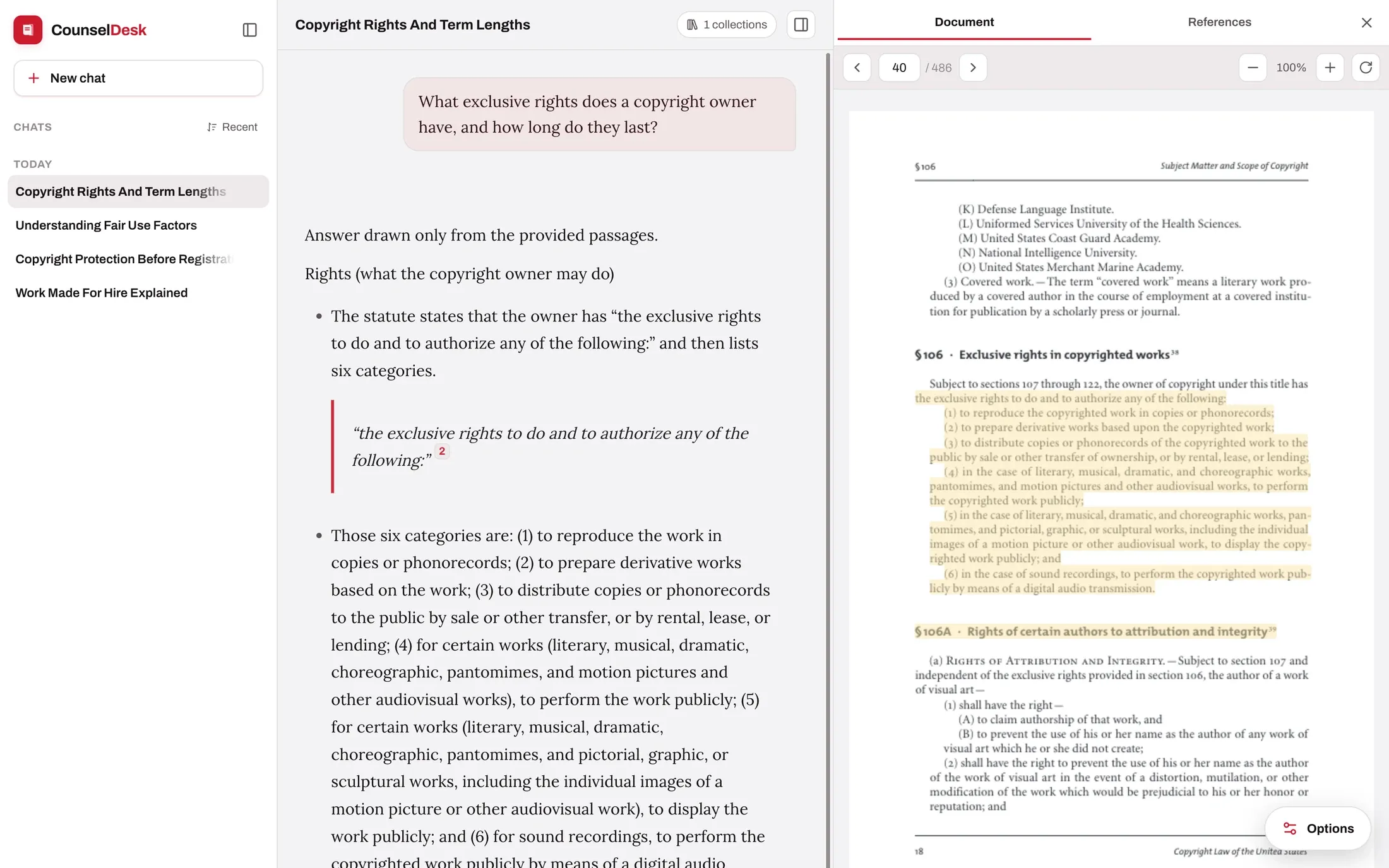
When the library has nothing on the question, the reader sees a refusal instead of a guess:
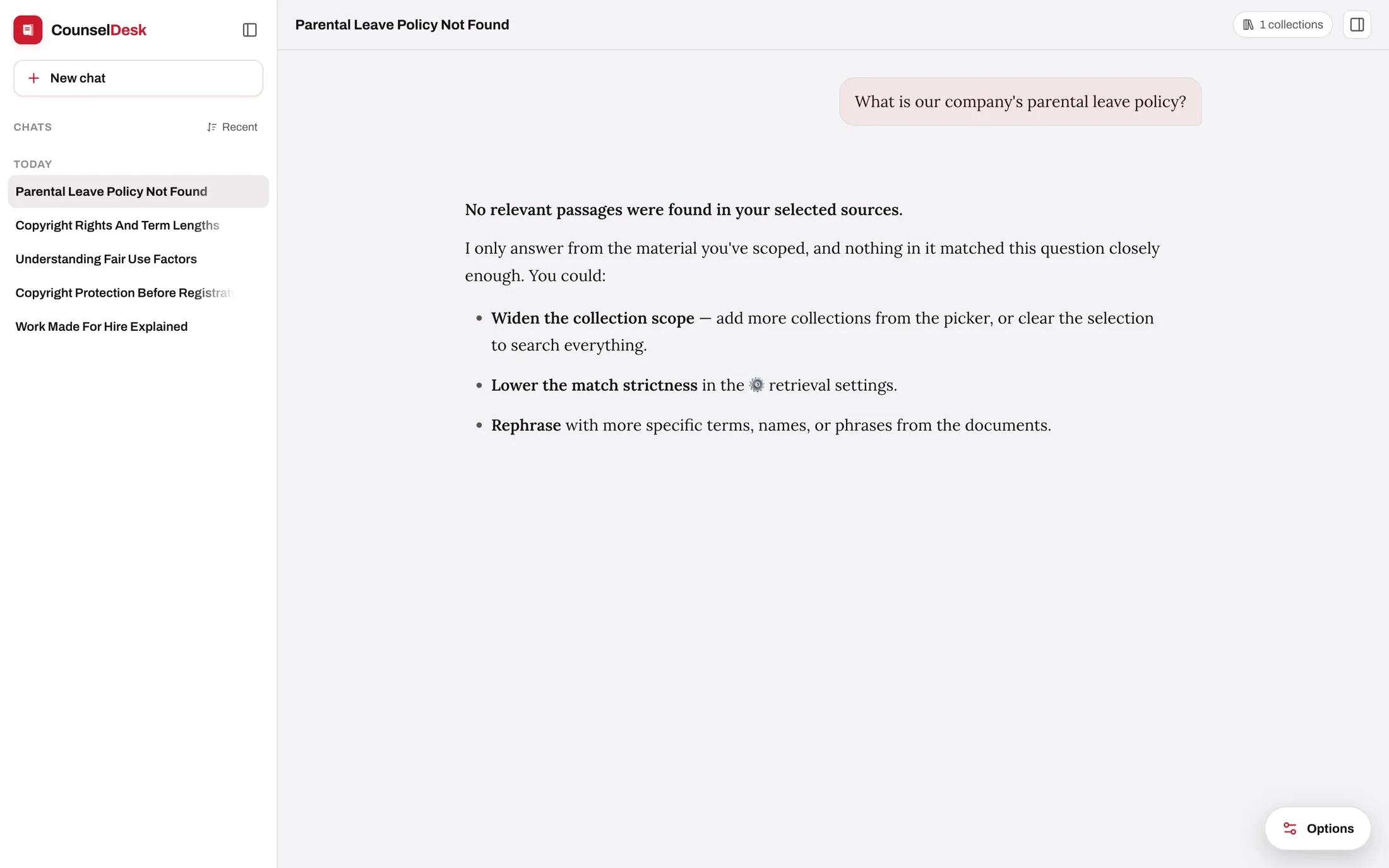
Please note the two kinds of guarantee here. That a citation points to a real retrieved passage is enforced in code. That the passage really supports the sentence beside it is only made likely, and measured; I do not think any honest vendor can promise more today. The general techniques are in our articles on chatbots that don’t hallucinate and RAG for legal documents, and the full pipeline is described on edtek.ai.
What does an AI chatbot for publishers look like in production? The AAAi Chat Book
The AAAi Chat Book is the public example, and anyone can try it. The American Arbitration Association launched the first edition, based on Case Preparation and Presentation by Jay E. Grenig and Rocco M. Scanza, in January 2025 (LawNext, AAA press release). It is free and public. Four editions are live now: Case Preparation and Presentation, Fundamentals of Labor Arbitration, Arbitration for Non-Attorneys and Mediation Practice.
The edition for people arbitrating without a lawyer came out in December 2025. About 30 per cent of AAA cases involve at least one self-represented party (LawNext, December 2025). For that audience, a plain-language answer with the page next to it is what makes the handbook usable. The AAA’s January 2025 announcement names Edtek as its partner, and every Chat Book page says it is powered by Edtek.AI; Edtek is the product we build at 4xxi. The AAA has been our client since 2023, with work planned through 2028, and the Chat Books have handled thousands of queries.
A breakthrough in making arbitration more efficient, accessible and fair.”
Three lessons from it apply to any publisher. Firstly, many people ask short, practical questions (‘What’s the deadline for filing a counterclaim?’) rather than the complex multi-part questions we expected. Secondly, non-lawyers ask what words mean, so the same book quietly becomes a glossary. Thirdly, the quality of ingestion is the quality of search: every shortcut in extracting and structuring the text came back later as a bug in search. The longer story is in our AAAi Chat Book case study, and the wider context in AI for arbitration.
How do you plug it into an existing publishing platform?
Through integration work: content synchronisation from the system you already publish from, deployment into your own cloud account, your own model keys and sign-in. That is normal, since the chatbot is only the visible part. A good example is a legal publisher we work with right now. They did not want one more website; they wanted the answer layer inside the platform their readers already use.
Three people from our side work on it, together with the publisher’s own developers and devops engineers. We took Edtek, integrated it with their platform, deployed it into their infrastructure and automated the deployments, so their team can ship without waiting for us. A good part of the work is advice on how to do all of this properly. Along the way, as a side project, we also helped them bring AI into their internal processes. The whole plan is roughly 6–8 months, in several iterations.
What a deployment of this kind usually includes:
- Content synchronisation. Documents and metadata come from the system you already publish from, instead of being uploaded twice.
- Usage export. A CSV of which documents were retrieved for which questions, when and in which deployment. That is the basis for per-title royalty reporting to authors. O’Reilly took the same route in 2024: every answer in O’Reilly Answers carries citations, and the usage data lets O’Reilly pay its experts a royalty for each answer delivered (O’Reilly Radar, June 2024).
- Infrastructure as code. Terraform and Kubernetes into your own Azure, AWS or DigitalOcean account, or onto your own hardware. On Azure even the model can run inside your tenant.
- Your models, your keys. OpenAI, Azure OpenAI, OpenRouter or any OpenAI-compatible endpoint, under your own credentials.
- Sign-in. Email and password, one-time codes or Google out of the box. SAML is not switched on by default; if your platform needs it, we add it as part of the integration.
At the other end of the scale, we have done engagements of a few days where the only task was to deploy. How we work inside a client’s team in general is described in working alongside your in-house team.
Is there more than chat? Draft, Cite and educational publishers
Yes, but Chat is where our production experience is. Edtek has two more products; here is only what they do today.
Edtek Draft is a document builder. It extracts a reusable template from your existing documents, generates documents in batch from a data source, and runs section-level tasks against your knowledge base: verify a claim, rewrite a clause, check consistency. For a publisher the obvious uses are author agreements, subsidiary rights licences and permissions.
Edtek Cite reads a document, finds claims and references to authorities, and annotates them inline with the relevant rule, case or regulation, a short summary and a link to the source. It can also check claims against your own reference materials, which makes it useful for manuscript fact-checking. Why that matters in law is covered in our piece on citation verification in legal AI.
Both are younger than Chat. I would rather show them on your documents in a demo than promise numbers here.
Educational publishers are a close case. The client behind EmanuelAYCE has worked with us since 2013. EmanuelAYCE is the law school study platform we built for them in 2022 around Emanuel Outlines, CrunchTimes and Casenotes. In 2023 we added an AI tutor that reviews student answers, points to mistakes and guides the student towards the right answer from the same content. More on that in how LLMs are changing legal education. The grounding is the same, but the direction is reversed: the book is checking the student.
Can a professional association or standards body use it?
Yes. Associations and standards bodies fit the same pattern as the AAA. One installation can run a public chatbot and a members-only one over the same library, each with its own collections, branding and members. Each chatbot searches only the collections it was granted, so members-only content does not appear in public answers. Members sign in with email and password, one-time codes or Google. If your member system uses SAML, we add it as part of the integration.
What does it take: rights, formats, evaluation and cost?
Less technology than people expect, and more preparation. A plain deployment takes days and a deep platform integration takes months; the Edtek licence is priced on request, and integration work is billed at our standard rate of $200 per hour. Here is the checklist we go through before a deployment:
| Item | Why it matters | What to prepare |
|---|---|---|
| Content rights | You need the right to use the text in an AI product, and authors may care how | Check author and licence agreements for digital and derivative uses |
| Formats | PDF gives page references; Word and Markdown highlight the cited block instead | PDFs with a real text layer, final editions rather than drafts |
| Scope | Each chatbot searches only the collections it was granted | A list of collections per audience: public, members, subscribers |
| Evaluation | Without it, answer quality is an opinion | A few dozen real reader questions, including ones your books do not answer |
| Infrastructure | Decides where content and model calls live | A cloud account, a model contract, and who owns devops on your side |
| Reporting | Royalties, cost per answer, unanswered rate | Who receives the usage export, and in what shape |
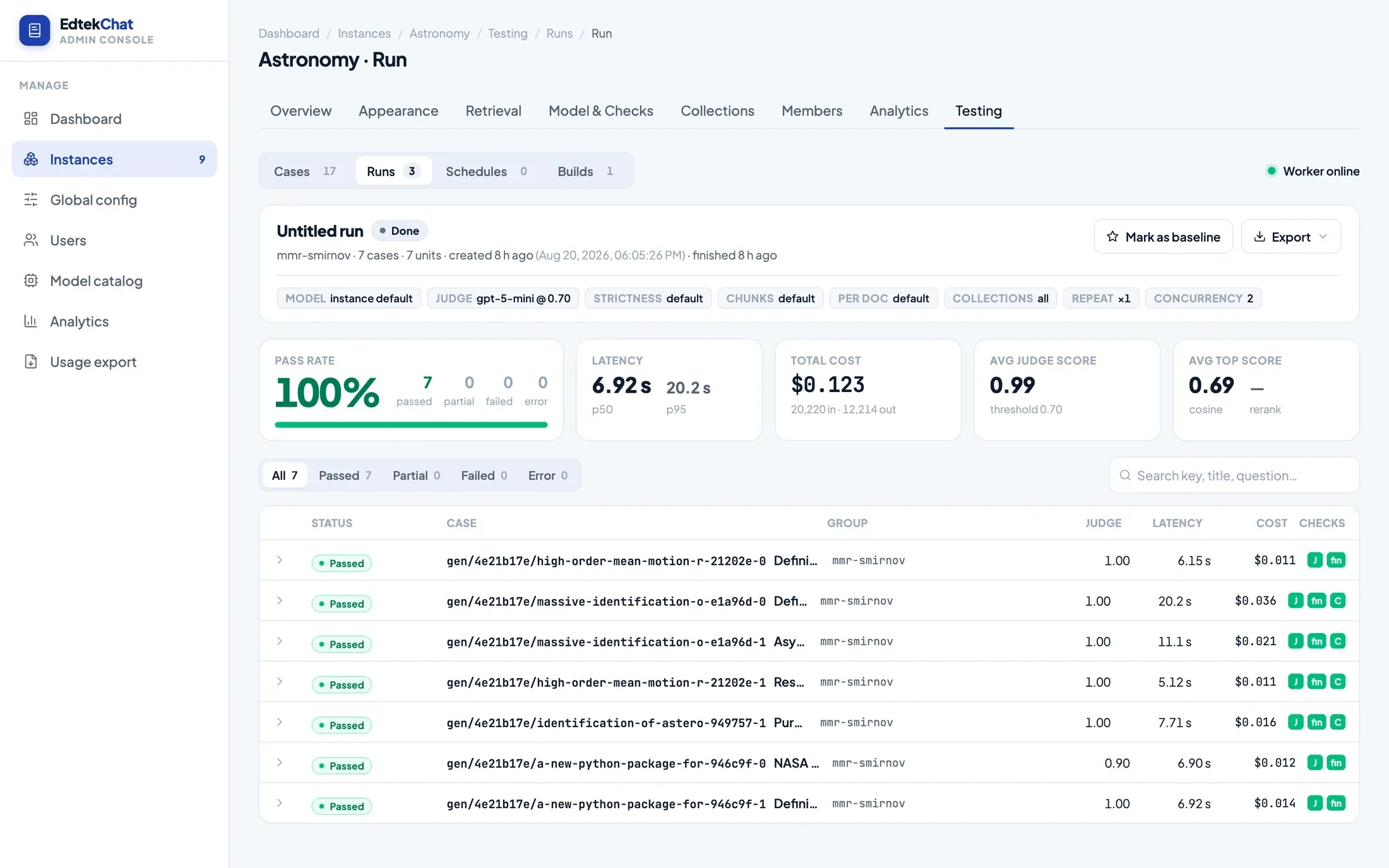
Evaluation is where most chatbot projects are weakest. Edtek Chat ships with a regression suite for its own answers: golden questions with reference answers, an LLM judge, and deterministic checks on retrieval, refusals, wording and latency, with the cost of every run recorded. Each case can run up to ten times, and the worst result counts, so an intermittent failure cannot pass by luck. A test builder drafts cases from your documents, switched off until a person reviews them. You mark a run as the baseline, change a model or a threshold, and get a list of what regressed. The method is described on edtek.ai.
Now the cost. Edtek is sold as software under a non-exclusive licence, and we quote the price on request. Integration, custom features and consulting are billed at our standard rate of $200 per hour, the same for all our work. Whatever we build specifically for you in that work (code, prompts, evaluation sets) belongs to you. For general budgets see how much custom AI development costs.
When don’t you need this?
Quite often. I would not recommend Edtek, or us, in these cases:
- Your content is small, public and nobody pays for it. A hosted ‘chat with your files’ service will do the job for a fraction of the effort.
- Your books are read front to back. Fiction, poetry and purely narrative works gain little from a chatbot; reference works, handbooks, treatises, standards and textbooks gain the most. The Edtek guide to converting a book into a chatbot goes through which titles fit.
- You only want licensing revenue. If the plan is to sell your archive to AI companies and not to build a reader product, you need a rights lawyer, not a chatbot.
- You want answers beyond your content. Edtek Chat refuses by design when the library has no answer. If your readers expect general knowledge mixed in, it will disappoint them.
- Your value is news and traffic. Chatbots for news sites are built for engagement and ad revenue, which is a different product.
- Procurement requires a vendor with its own SOC 2 report on day one. Edtek does not have a SOC 2 report of its own yet. We have been through SOC 2 reviews together with clients, and SAML sign-in is a small addition, but if a certificate is a hard gate before the first conversation, it is better to know it now than in month three.
What should you do next?
To sum up: the asset is your content and the page reference behind every answer. The model is replaceable.
The fastest way to see whether this fits your library is to test it on your own questions, not ours. Send us a handful of the questions your readers actually ask, including a few your books do not answer. We will build them into an evaluation suite and show you the report: what was answered, what was cited, what was refused. Book an Edtek demo or pick a slot in my calendar.
If you already have a chatbot over your content and are not sure how it behaves, start with an AI audit instead. Here is what we check when we audit an AI system someone else built.