Edtek Chat
Grounded AI chat over your own documents, with a citation on every claim.
Overview
Publishers, legal teams and professional services firms own some of the most reliable content there is: treatises, rulebooks, handbooks, internal policies. Their readers increasingly skip it and ask a general-purpose chatbot instead. The answers sound right and often are not. The source stays accurate and unread.
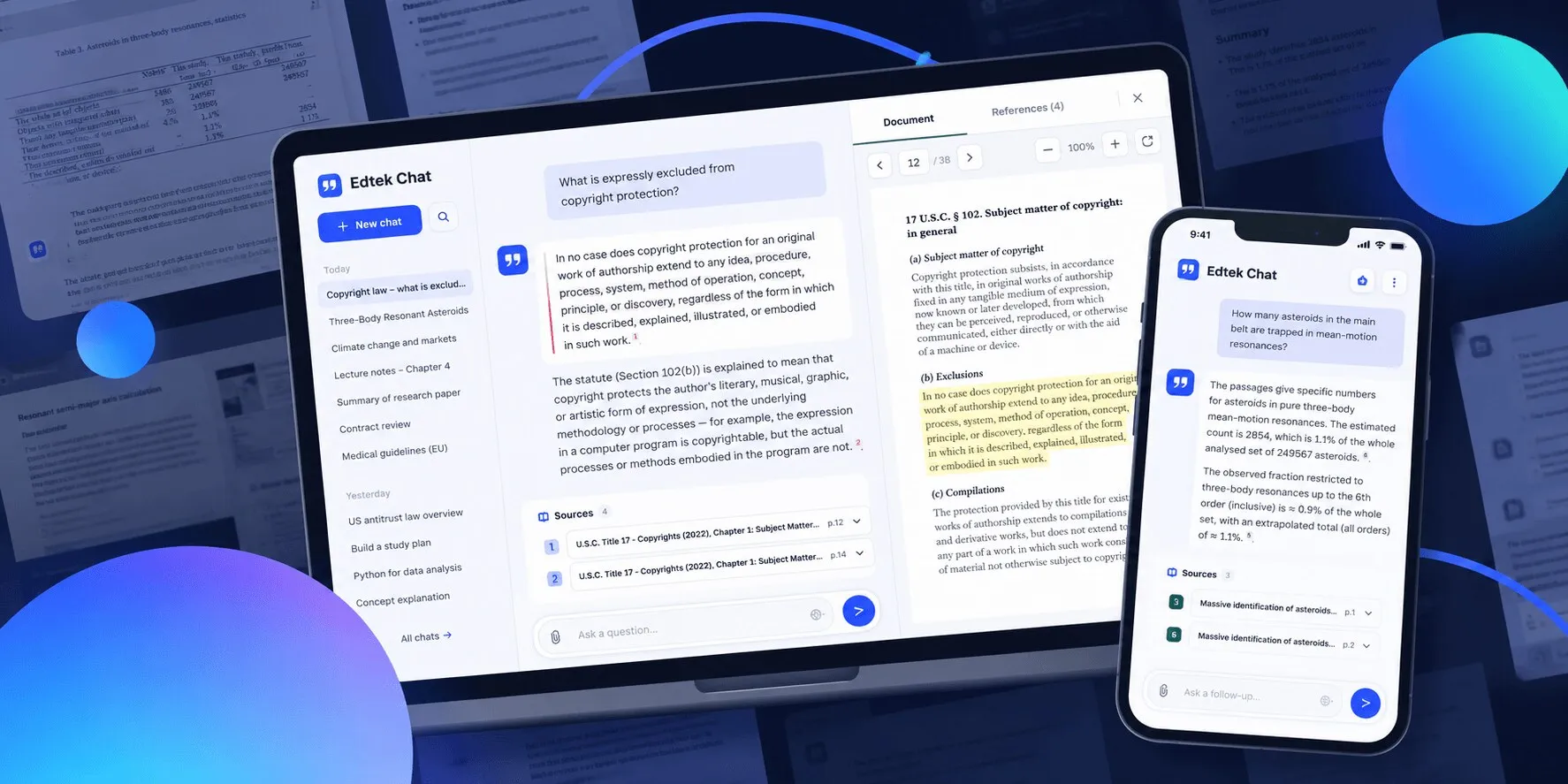
Edtek Chat makes that content answer questions itself. A reader asks in plain language. The system searches the organisation's own collections and answers only from the passages it found. Each claim carries a numbered citation that opens the document beside the answer, at the cited page, with the passage highlighted. It is the flagship of Edtek, our own product, which also includes Edtek Draft, a document builder, and Edtek Cite, inline annotations with the rules and authorities behind every claim.
What makes it different
Grounding is enforced in code, not only asked for in a prompt. Citation numbers are assigned by the retrieval step, not written by the model, and any reference to a passage that was not retrieved is removed before the answer is shown. If nothing in the selected sources matches a first question, the model is not called at all: the reader is told the library has no answer and what to try instead. Answers built on weaker matches are labelled as such. Optional relevance and verification passes add a second model that filters passages before answering and reviews the draft against its citations afterwards.
Accuracy is measured, not demonstrated. An evaluation suite runs golden questions through the same pipeline that serves readers, with an LLM judge, retrieval assertions, confidence checks and latency budgets, and compares each run against a baseline to catch regressions.
What we delivered
- The chat app. Streamed answers with inline citations, a built-in viewer for PDF, Word and Markdown sources, scoping by collection or by single title, conversation history, and shareable read-only transcripts that keep the documents private.
- One installation, many chatbots. Each instance has its own URL, branding, welcome screen, prompt, model, retrieval settings, members and set of collections. An operator console configures all of it, with every setting inherited from a global default unless overridden.
- The retrieval service. Documents are uploaded into nested collections, split without breaking sentences, embedded and stored in the customer's own vector index, with reranking and search tuning per deployment.
- Your models, your infrastructure. OpenAI, Azure OpenAI, OpenRouter, Cohere for reranking, or any OpenAI-compatible endpoint, with API keys encrypted at rest. The whole stack can run on-premise, so content and inference can stay inside the customer's network.
- Operations and accounting. Usage and cost per instance, an audit log, input moderation, and a usage export of cited documents that supports royalty accounting for publishers.
The result
The American Arbitration Association's AAAi Chat Book series is built with Edtek. The first edition launched in January 2025, and the series has since grown to include editions for labor arbitration, non-attorneys and mediation practice. The same product now lets any publisher or firm turn a library it already owns into a chatbot its readers can check, line by line.
At a glance
- Industry
- LegalTech · AI/ML
- Delivery
- AI/ML · Web · API
- Stack
- TypeScript
- Next.js
- React
- AI SDK
- PostgreSQL
- ChromaDB
- Redis
- ZenStack
- Topics
- LegalTech · AI · RAG · Publishing · B2B Platform
- Timeline
- 2024–now
Related articles
- Legal
Citation Verification in Legal AI: Why Accuracy Matters More Than Speed
Even Lexis+ and Westlaw hallucinate on 1 in 6 queries. Here's how to build legal AI that verifies every citation — techniques, architecture, and why this is the most important layer in your stack. - AI engineering
Building AI Chatbots That Don't Hallucinate: Anti-Hallucination Techniques for Enterprise
RAG grounding, confidence scoring, citation verification, output validation — practical techniques to build enterprise AI that earns trust through accuracy.